Utsynsmeldinga aims to contribute to high employment and cover essential skills needs in working and social life. The report points to the most crucial competence needs going forward and explains the government's measures.
NMH critical of Utsynsmeldinga

The Ministry of Education and Science has presented the "Overview of skills needs in Norway". NMH is critical on behalf of art education.
— We are concerned about a logic of practical thinking that downplays the entire field of humanities and arts.
to the newspaper Klassekampen on 4 April
NMH seeks support from organisations and politicians
The Norwegian Academy of Music is contacting other schools, the University and College Council, organisations, media and politicians.
The aim is to get through before the Audit Report is heard in the Education and Research Committee on 24 April and is processed in the Storting on 1 June 2023.
— The signal is that art educations are to be de-prioritised and that we do not want funding to create new study places.
to Khrono on 31 March

Art education should increase
NMH wants arts education to be treated like medicine, veterinary medicine and dentistry when it comes to performance funding and new study places.
Being placed in the top funding category will make visible what performing music education costs, without this amounting to any additional expenditure over the State Budget.
Errors in Utsynsmeldinga
Two of the claims in Utsynsmeldinga are that the capacity in arts education has increased by 280 per cent since 1999, and that many people are being educated for unemployment. The Norwegian Academy of Music believes these two main premises in the White Paper are incorrect.
One source of error is the figures in the state reporting system (DBH) and the fact that programmes were not classified in the same way in 1999 and 2022.
- As private institutions were initially not included in DBH, they count as zero in 1999, but are counted in full in 2022. Many private programmes that were previously classified as vocational college (fagskole) programmes were not included, whereas they are now bachelor’s programmes and therefore counted in full.
- Many arts programmes have also been miscategorised in more recent years, particularly in that DBH has included programmes that are not performance- or creation-based arts education.
When we correct for these errors in the data, the overall increase in capacity in the arts subjects has been approximately 37% since 1999. Most of this increase has been in architecture, design and performing arts. Performance-based music education has seen a 3 per cent increase over the past 24 years.
Those educated in creative and performance-based music are not excluded from working life
Regarding the claim about employment challenges, the White Paper discusses in some detail the high degree of “mismatch” between the humanities and aesthetic subjects in general. However, this is a large and heterogeneous group of programmes.
If we look at the figures for the specialised arts institutions – the Oslo School of Architecture and Design, the Oslo National Academy of the Arts, and the Norwegian Academy of Music – these show that graduates from these institutions are at, or in some cases significantly below, the sector average. The Nordic Institute for Studies in Innovation, Research and Education (NIFU) also carried out a dedicated graduate survey for music programmes in 2014, in which they concluded that “unemployment is a marginal problem among newly qualified music graduates” and that “when it comes to irrelevant work, this is slightly less prevalent among music graduates than among graduates with higher degrees in general”.
NMH and Utsynsmeldinga in the media image
There is only a short time since the report was presented on 24 March and until the committee hearing on 24 April. Some media have started to write about the criticism of the Utsynsmeldinga.
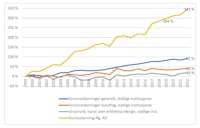
Utdanningskapasitet i høyere kunstutdanning
Bakgrunnen for notatet er høyst misvisende informasjon i Utsynsmeldingen om svært stor vekst i utdanningskapasiteten i høyere kunstnerutdanning. Kjetil Solvik redegjør for feilene som er gjort, og gir deretter et bedre tallgrunnlag for å vurdere veksten.
Les hele notatet