For employees Search

The Principal's Speech at the Semester Conclusion 2026

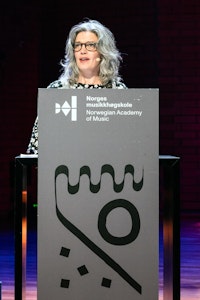
"It is so easy to be proud of the Norwegian Academy of Music!" said Principal Astrid Kvalbein in her speech at this year's semester conclusion.

Dear students, dear colleagues, visiting family members, and all good friends of the Norwegian Academy of Music, welcome to the formal celebration marking the end of this academic year!

Today, we especially celebrate those completing their bachelor's, master's, and doctoral degrees.

We symbolically hand out roses and flowers to mark the conclusion of many journeys – short or long – that lead into working life, out into the world, or perhaps into further studies at this academy or elsewhere.

We also mark the conclusion of an academic year. Or is it really many years? As many different years as there are people in the room?

I have sometimes said, half-jokingly, that there are as many Norwegian Academies of Music as there are staff and students, both current and past. Indeed, I find that many have their own individual, often strong stories about what this institution means to them. Perhaps there is some truth to that.

At the same time, we are very much a shared arena, a community. We share some or several years in a large building with many rooms, both in the literal and metaphorical sense. Our spaces practically extend to Karl Johan, other parts of the city, the entire country, and out into the world. The rooms at the Academy are created for us to pursue what we are passionate about and love. NMH is meant to be a place where we feel this love often enough to endure all the mundane aspects that also exist in an arts academy—whether it is warm-up exercises and perfecting technique, heavy reading, or, for that matter: stubborn IT systems and Excel sheets, writer’s block, tennis elbow, or challenges that are heavy and difficult in more serious ways.

I hope and believe that those of you now moving on feel that your years here have lifted and developed you as individuals through your work with music and that you feel ready for the next stage.

I also hope and believe that you have realised NMH is not an isolated island. We are part of a large ecosystem where music thrives through teaching and concerts, festivals and dementia choirs, in theatre and film, in amateur bands, and in the ears of many people as individual accompaniment to all sorts of activities.

We work to ensure that your time of study has provided you with tools and experiences to take into these ecosystems and that your education has prepared you for a long and fulfilling professional life in music, wherever you find your place. Perhaps you will also return for further professional development—you are most welcome to do so!

Vice-pricipal Vivianne Sydnes gratulates the to the graduating students.

When I look back on my year as principal at NMH, I see that one of the defining features has been political engagement and advocacy – more so than last year, for example.

As the leader of what we sometimes call "Norway's highest school of music," I have followed with concern and raised my voice against the proposed cuts and the senseless reorganisation of the Oslo School of Music and Performing Arts.

In this matter, and in an initiative to save a unique orchestral programme for children and young people in the Haugerud district – a relatively vulnerable area of the city – I was also pleased to see colleagues from our music pedagogy community write opinion pieces.

What was decisive in these cases, we may never know, as many people spoke up. Regardless, it was good to see that the cuts and reorganisation were reversed, and that the orchestra will now continue, thanks to funds that were found at the eleventh hour.

After several years of lobbying our own ministry, the Ministry of Education and Research, it also seems that we are about to regain a funding scheme for artistic research and development. The project programme, which was lost with the so-called trust reform, may now return under the Research Council of Norway.

We are pleased about this, after years of argumentation, persistence, and, not least, a collective effort by many of us involved. This includes not only those of us in arts education but also the Norwegian Association of Higher Education Institutions on behalf of the entire sector.

In January, the online newspaper Khrono, which covers this sector, wrote that I "put the minister on the spot" regarding this issue during contact conferences with the ministry. The response from Sigrun Aasland also indicated that she felt somewhat pressured.

But in April, she visited us here at NMH, and the atmosphere was very pleasant.

The minister was invited into Are Sandbakken's room, where there "coincidentally" happened to be a trio of trombone students we could proudly showcase – all of whom already had good jobs out there—but above all: played so beautifully that it brought a lump to her throat and tears to her eyes. I saw it.

She also experienced an electrifying session in the percussion room and had a go at driving a remote-controlled car equipped with an electric guitar in the electroacoustic studio. There, she met student Ola, who (unprompted, actually) said exactly what we hoped he would: "NMH is great, but it's just a bit cramped."

We had to address that with Aasland as well, emphasising that our space problem could be resolved within a few years if we receive goodwill – and funding – to lease facilities at Marienlyst when NRK moves out.

We'll see how that matter develops. But that little tour with our minister – which ended here in this hall with a magnificent piece of organ music by Egil Hovland – reminded me of a feeling I often have:

It is so easy to be proud of the Norwegian Academy of Music!

Even on ordinary days, without a minister in tow, I can simply take a walk through the hallways, meet students and colleagues, poke my head into a room, or attend a concert in the evening.

And then I'm reminded of why I sit through all the meetings, debate with politicians, strive to build and take pride in IN.TUNE, the European university alliance in music and arts, alongside seven other institutions.

It’s the magical moments, the challenges overcome, the learning that takes place, and the incredible experiences that are created – at concerts and rehearsals, in teaching, in music therapy practice, simply in all forms of collaboration.

For those of us who work with music, we don’t need many words to feel in our core that what we do is important, and we can usually articulate why as well. Why it matters to us, and why it matters to society as a whole.

The political battles we face – and will likely face more of in tougher times ahead – remind us that we also need to be well-prepared to convince others of the value of what we do.

There is meaning, power, and joy in music. And we truly believe in you!

Astrid Kvalbein to the graduating students

The best ambassadors for this are you, who are now leaving this place.

As I said, I hope you feel well-equipped to move forward with music. If it doesn’t feel that way every day, so be it. It might also be the case that you’re a bit tired now, after the journey the academic year 2025–2026 has been for you.

Perhaps the best thing now is actually to take a break, let the exam and performance mode rest, let your shoulders relax, take a deep breath, and rediscover the playful, simple joy of just being able to make music. In your own way.

Let that be my only piece of advice in today’s speech: Seek out the pure joy of music. Embrace it and carry it with you into the world—as performers, educators, healthcare workers, researchers, freelancers with many different tasks—or whatever you become.

There is meaning and power in that.

Will you let that sink in as we now listen to a performance of new and old, folk-infused Scottish music?

There is meaning, power, and joy in music. And we truly believe in you!

Research fellows who have defended their dissertations this academic year. From left: Hanne Rinholm, Rune Rebne, Tora Ferner Lange, Gaute Storsve and Marianne Berglöf.

Articles relevant